
IL-6 Inhibition in Non-Infectious Uveitis
IL-6 — More Than Just an Inflammatory Cytokine
- Discovered in the 1980s, IL-6 initially went by several different names because different laboratories discovered its different biological effects independently.
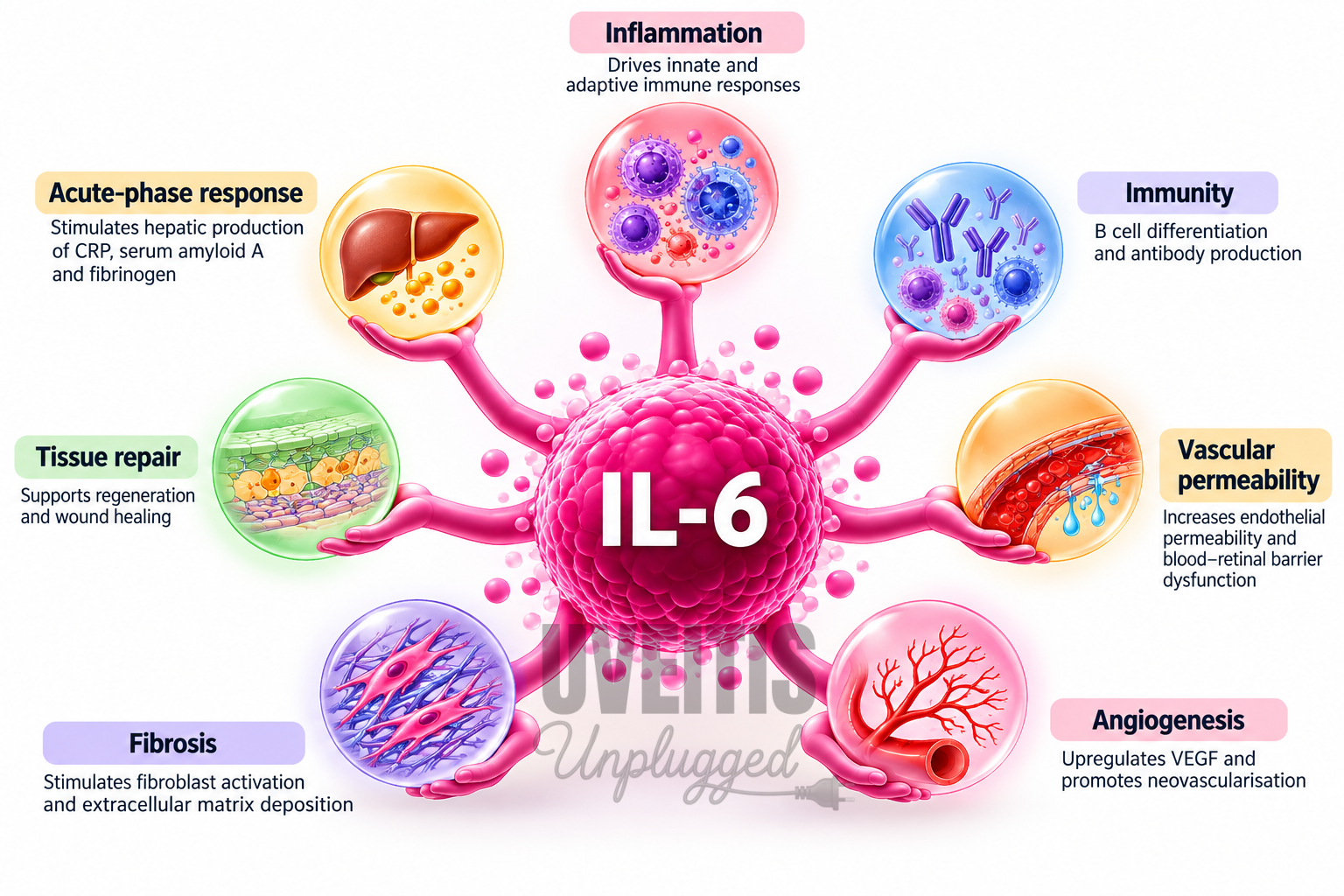
- One molecule, many roles: IL-6 influences inflammation, immunity, hematopoiesis, metabolism, angiogenesis, and tissue repair.
- A master acute-phase signal: IL-6 stimulates the liver to produce CRP, serum amyloid A, and fibrinogen.
- A T-cell switch: Together with other cytokine signals, IL-6 can promote Th17 differentiation and influence the Th17–Treg balance.
- Context matters: IL-6 signaling can contribute to host defense and tissue repair, but persistent or dysregulated signaling can drive chronic inflammation and autoimmunity.
- The eye is not just a bystander: retinal and ocular cells can produce IL-6, and increased intraocular IL-6 has been described in several inflammatory retinal conditions.
- Beyond inflammation: IL-6 is linked with VEGF expression, vascular permeability, angiogenesis, and fibrosis—making it particularly relevant to retinal disease.
How IL-6 causes uveitic macular oedema
- Immune shift: IL-6 pushes naïve T cells towards Th17 cells and away from regulatory T cells, so inflammation keeps going (2).
- VEGF induction: IL-6 raises VEGF, which makes vessels leak (2).
- Barrier breakdown: IL-6 disrupts ZO-1 tight junctions in RPE cells, and IL-6R blockade reverses this in vitro. This points to the outer blood–retinal barrier (3).
- Made inside the eye: aqueous IL-6 is high while serum IL-6 is normal (4), and levels are higher in active than in quiet uveitis (5).
Mechanism of Action:
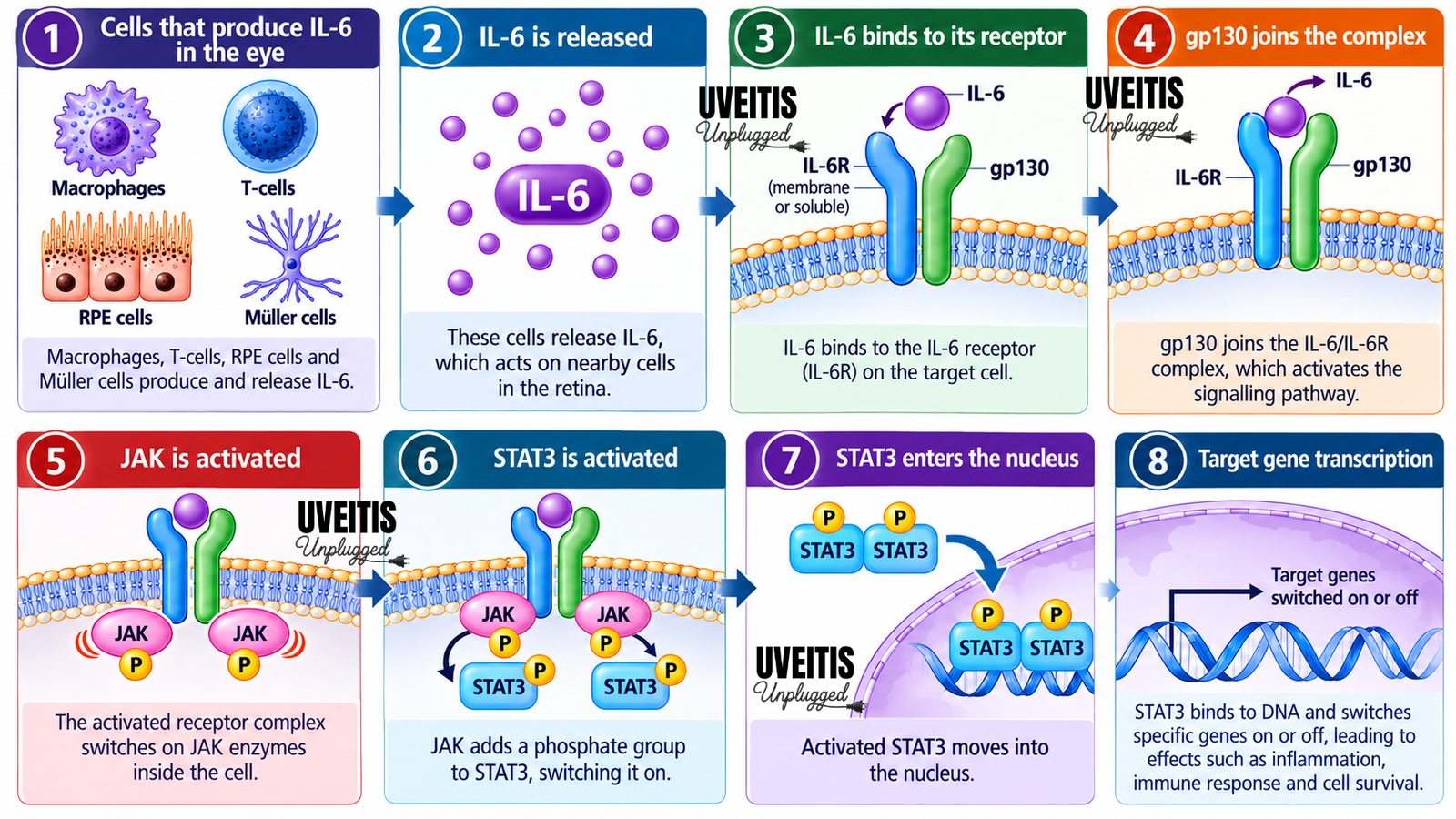
IL-6 is a message produced by several cells in the eye, including macrophages, T-cells, RPE cells, and Müller cells. Once released, IL-6 travels to nearby cells and delivers an inflammatory signal. The sequence is like this: Macrophages / T-cells / RPE / Müller cells → IL-6 → IL-6R → gp130 → JAK → STAT3 → Nucleus
- IL-6 is produced and released by macrophages, T-cells, RPE cells, Müller cells, and other cells.
- IL-6 binds to IL-6R — its specific receptor, like a key fitting into a lock.
- gp130 joins the complex and carries the message across the cell membrane.
- JAK is activated inside the cell.
- JAK switches on STAT3 by phosphorylation.
- Activated STAT3 enters the nucleus and switches particular genes on or off.
- The result is a change in cellular behaviour, including inflammation, immune activity, and cell survival.
How the Drugs Block IL-6
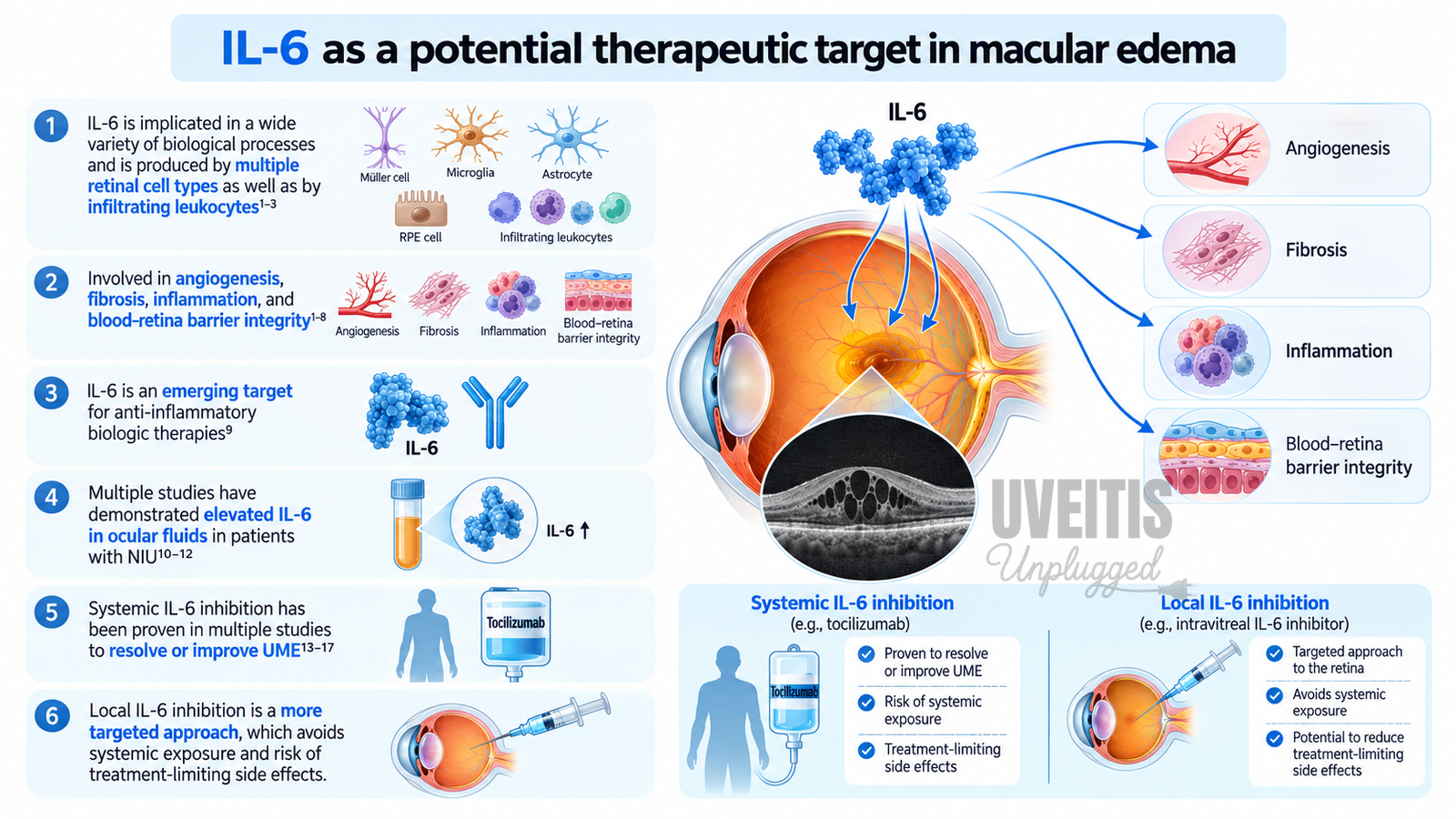
Two strategies exist. Tocilizumab and sarilumab block the receptor and are given systemically. Vamikibart blocks IL-6 itself and is injected into the vitreous (6).
Receptor blockers versus ligand blocker
|
Tocilizumab / sarilumab (systemic) |
Vamikibart (intravitreal) |
|
|
Target |
IL-6 receptor, membrane-bound and soluble |
IL-6 itself (the ligand) |
|
Signalling blocked |
Cis- and trans-signalling, throughout the body |
Cis- and trans-signalling, within the eye |
|
Antibody class |
IgG1 |
IgG2, engineered for intravitreal use* |
|
Persistence |
Serum half-life about 21 days |
Barely detectable in blood; ocular half-life about 7.5 days* |
*Sponsor data presented at ARVO 2023; not yet peer-reviewed.
Two practical points on receptor blockers: tocilizumab suppresses CRP and fever, so an infection can hide behind a normal CRP. Serum IL-6 also rises on treatment because the blocked receptor can no longer clear it; this is expected and is not treatment failure.
The Evidence Trail: A Timeline
From discovery to phase 3
|
Year |
Milestone |
|
1986 |
IL-6 cloned by Kishimoto's group, first named B-cell stimulatory factor 2 (7) |
|
1990 |
Raised aqueous IL-6 first reported in uveitis (4) |
|
2005–2010 |
Tocilizumab licensed for systemic disease: Castleman disease in Japan, then rheumatoid arthritis (FDA 2010) |
|
2006 |
Aqueous IL-6 linked to uveitis activity (5) |
|
2013 |
First series: systemic tocilizumab dries refractory uveitic CME (8) |
|
2014 |
Benefit holds at 12–18 months; CME relapses when the drug is stopped (9) |
|
2016 |
Tocilizumab series in JIA uveitis and in refractory UME (10,11) |
|
2017 |
STOP-Uveitis: first randomised trial of tocilizumab in non-infectious uveitis (12) |
|
2017 |
Intravitreal anti-IL-6 attenuates mouse uveitis: first proof that local blockade works (13) |
|
2018 |
Tocilizumab in Behçet uveitis after interferon and anti-TNF failure (14); 24-month UME outcomes (15) |
|
2019 |
SATURN phase 2 (sarilumab) (16); 25-patient multicentre tocilizumab series (17); IL-6 breaks the RPE barrier in vitro (3) |
|
2019–2023 |
DOVETAIL phase 1 of intravitreal vamikibart runs at 18 US sites (6) |
|
2020 |
APTITUDE: tocilizumab in anti-TNF-refractory JIA uveitis (18); paediatric intermediate and panuveitis series (19) |
|
2022 |
French Uveitis Network: tocilizumab versus anti-TNF in 204 patients (20) |
|
2023 |
Review of IL-6 inhibition in UME (2); MEERKAT and SANDCAT phase 3 trials begin |
|
2024 |
Intravitreal anti-IL-6 preserves visual function in mice (21) |
|
2025–2026 |
MEERKAT and SANDCAT results presented (AAO 2025, ARVO 2026) |
|
2026 |
DOVETAIL published (6) |
Licensing dates are regulatory events and are not indexed in PubMed.
Proof of Concept: Systemic IL-6 Blockade in 12 Studies
Systemic tocilizumab and sarilumab have been tested across the full range of non-infectious uveitis. The table below summarises the 12 key studies in refractory UME (2).
Table. Refractory uveitis-related CME treated with systemic IL-6 inhibitors (adapted from Yang et al.)
|
Study |
Drug (route) |
Design |
n |
Uveitis type |
F/U (mo) |
Primary outcome |
Primary efficacy |
ME improved |
Definition of improvement |
|
Adán 2013 (8) |
TCZ (IV) |
CS |
5 |
BCR 3, JIA 1, idiopathic panuveitis 1 |
8 |
CFT |
100% |
100% (5/5) |
CFT <350 |
|
Mesquida 2014 (9) |
TCZ (IV) |
CS |
7 |
BCR 3, JIA 3, idiopathic panuveitis 1 |
15 |
CFT |
100% |
71% (5/7) |
CFT <350 |
|
Tappeiner 2016 (10) |
TCZ (IV) |
CS |
5§ |
JIA |
12 |
IOI |
100% |
100% (5/5) |
N/A |
|
Deuter 2016 (11) |
TCZ (IV) |
CS |
5 |
JIA 2, AS 1, RA 2 |
14 |
CFT |
75% |
100% (5/5) |
≥25% CFT reduction |
|
Sepah 2017 (12) |
TCZ (IV) |
RCT |
37 |
Idiopathic 28, sarcoid 2, VKH 2, BCR 2, PIC 1, BD 1, TINU 1 |
6 |
IOI |
44% |
100% (15/15) |
N/A |
|
Eser Ozturk 2018 (14) |
TCZ (IV)‡ |
CS |
5 |
BD |
10 |
CFT |
100% |
80% (4/5) |
N/A |
|
Mesquida 2018 (15) |
TCZ (IV) |
CS |
12 |
JIA 6, BCR 2, idiopathic panuveitis 2, SO 1, AS 1 |
24 |
CFT |
100% |
83% (10/12) |
CFT <350, cysts resolved |
|
Heissigerová 2018 (16) |
SAR (SC) |
RCT |
58 |
Intermediate 12, posterior 14, panuveitis 29 |
4 |
RSU |
46% |
100% (58/58)† |
≥20% CFT reduction |
|
Vegas-Revenga 2019 (17) |
TCZ (IV) |
CS |
25 |
JIA 9, BD 7, BCR 4, idiopathic panuveitis 4, sarcoid 1 |
12 |
CFT |
100% |
100% (25/25) |
CFT <300, cysts resolved |
|
Ramanan 2020 (18) |
TCZ (SC) |
SAT |
21 |
JIA (refractory to anti-TNF and MTX) |
9 |
IOI |
34% |
75% (3/4) |
N/A |
|
Wennink 2020 (19) |
TCZ (IV) |
CS |
7 |
Idiopathic 5, panuveitis 2 |
18 |
CFT |
100% |
100% (7/7) |
N/A |
|
Leclercq 2021 (20) |
TCZ (IV/SC) |
CS |
204¶ |
Idiopathic 97, BD 35, BCR 23, sarcoid 15, JIA 12, VKH 8, SpA 5, other 9 |
6 |
Composite (CFT <300 µm, RSU) |
36% |
56% (31/55) |
CFT <300, cysts resolved |
Rows are in chronological order; years follow the source table and may differ from the final print year. ‡Tocilizumab, confirmed from the original paper. †As given in the source table; SATURN reported oedema outcomes mainly for eyes with CST ≥300 µm at baseline. §Patients with macular oedema at baseline (17 treated in total). ¶Whole cohort, including 149 on anti-TNF agents; 55 received tocilizumab. AS, ankylosing spondylitis; BCR, birdshot chorioretinopathy; BD, Behçet disease; CFT, central foveal thickness; CS, case series; F/U, follow-up; IOI, intraocular inflammation; IV, intravenous; JIA, juvenile idiopathic arthritis; ME, macular oedema; MTX, methotrexate; PIC, punctate inner choroidopathy; RA, rheumatoid arthritis; RCT, randomised controlled trial; RSU, reduced steroid use; SAR, sarilumab; SAT, single-arm trial; SC, subcutaneous; SO, sympathetic ophthalmia; SpA, spondyloarthritis; TCZ, tocilizumab; TINU, tubulointerstitial nephritis and uveitis; VKH, Vogt–Koyanagi–Harada disease.
Systemic versus Local IL-6 Blockade
Intravitreal anti-IL-6 antibody reduced clinical, angiographic and histological inflammation in mouse uveitis (13) and preserved visual function (21). This opened the door to treating the macula alone.
Table . Pros and cons of each route
|
Systemic (IV/SC tocilizumab, SC sarilumab) |
Local (intravitreal vamikibart) |
|
|
Pros |
Treats both eyes and the systemic disease (JIA, RA, Behçet). Controls vitritis and posterior uveitis as well as oedema. Largest evidence base (Table 4). Works after anti-TNF failure. |
High drug level where the cytokine is made. Minimal systemic exposure: no neutropenia, lipid or liver signal expected. No steroid cataract or IOP rise. Suits eyes that cannot take another implant. |
|
Cons |
Neutropenia, raised lipids and liver enzymes, serious infection, bowel perforation. Needs blood monitoring; CRP masks infection. Drug at the retina limited by the blood–retinal barrier. Cost; largely off-label in uveitis. |
Repeated injections with their own risks (subconjunctival haemorrhage, IOP spikes, endophthalmitis). Treats the macula, not vitritis, choroiditis or systemic disease. Short follow-up; not yet approved. |
|
Best candidate |
Bilateral or systemic disease; anti-TNF failure; JIA |
Wet macula with otherwise quiet uveitis; steroid responder; glaucoma or post-filtering eye; young phakic patient |
What the Local Trials Show
The phase 1 DOVETAIL trial gave 37 adults with UME (CST ≥325 µm) intravitreal vamikibart 0.25, 1 or 2.5 mg at day 1, week 4 and week 8. At week 12, vision improved by 9.9 letters (about two lines) and CST fell by 165 µm, with benefit at every dose. There was one treatment-related event (transient blurring) and no retinal vasculitis, occlusive or non-occlusive (6).
The twin phase 3 trials, MEERKAT and SANDCAT, compared 0.25 mg and 1 mg with sham, given monthly to week 16. So far the results are conference data only. MEERKAT met its primary endpoint (≥15-letter gain); SANDCAT did not. Yet both dried the macula equally: CST fell by about 200 µm, and about three in five eyes became dry versus one in six with sham.
Table . Local IL-6 blockade: trials at a glance
|
Trial |
Design |
Key result |
Safety signal |
|
DOVETAIL (phase 1) (6) |
Open-label; 37 eyes; 3 doses |
+9.9 letters; CST −165 µm at week 12 |
No retinal vasculitis |
|
MEERKAT (phase 3)* |
Sham-controlled; n = 245 |
Primary endpoint met; ~60% dry |
No occlusive vasculitis reported |
|
SANDCAT (phase 3)* |
Sham-controlled; n = 256 |
Primary endpoint missed; similar drying |
No occlusive vasculitis reported |
*Conference data (AAO 2025, ARVO 2026; NCT05642312, NCT05642325); peer-reviewed publication awaited.
Reading the Evidence Honestly
- Short follow-up: phase 3 data run only to 16 weeks; durability and dosing interval are unknown.
- Inconsistent primary endpoint: MEERKAT succeeded and SANDCAT did not.
- No steroid comparator: there is no comparison with a dexamethasone implant or periocular triamcinolone.
- Oedema, not uveitis: the trials measure the macula, not vitritis, choroiditis or systemic disease.
- Who benefits most? Results by uveitis subtype are not yet available.
- Access: the drug is unapproved, and its cost in India is unknown.
References
- Ghasemi H. Roles of IL-6 in ocular inflammation: a review. Ocul Immunol Inflamm. 2018;26(1):37-50. PMID: 28146368.
- Yang JY, Goldberg D, Sobrin L. Interleukin-6 and macular edema: a review of outcomes with inhibition. Int J Mol Sci. 2023;24(5):4676. PMID: 36902105.
- Mesquida M, Drawnel F, Lait PJ, et al. Modelling macular edema: the effect of IL-6 and IL-6R blockade on human blood-retinal barrier integrity in vitro. Transl Vis Sci Technol. 2019;8(5):32. PMID: 31667008.
- Murray PI, Hoekzema R, van Haren MA, de Hon FD, Kijlstra A. Aqueous humor interleukin-6 levels in uveitis. Invest Ophthalmol Vis Sci. 1990;31(5):917-20. PMID: 2335453.
- van Kooij B, Rothova A, Rijkers GT, de Groot-Mijnes JD. Distinct cytokine and chemokine profiles in the aqueous of patients with uveitis and cystoid macular edema. Am J Ophthalmol. 2006;142(1):192-4. PMID: 16815285.
- Sharma S, Lin P, Hu A, et al. Interleukin 6 inhibition with vamikibart for uveitic macular edema: the phase 1 DOVETAIL nonrandomized clinical trial. JAMA Ophthalmol. 2026;144(5):442-451. PMID: 41954903.
- Hirano T, Yasukawa K, Harada H, et al. Complementary DNA for a novel human interleukin (BSF-2) that induces B lymphocytes to produce immunoglobulin. Nature. 1986;324(6092):73-6. PMID: 3491322.
- Adán A, Mesquida M, Llorenç V, et al. Tocilizumab treatment for refractory uveitis-related cystoid macular edema. Graefes Arch Clin Exp Ophthalmol. 2013;251(11):2627-32. PMID: 23893042.
- Mesquida M, Molins B, Llorenç V, Sainz de la Maza M, Adán A. Long-term effects of tocilizumab therapy for refractory uveitis-related macular edema. Ophthalmology. 2014;121(12):2380-6. PMID: 25204610.
- Tappeiner C, Mesquida M, Adán A, et al. Evidence for tocilizumab as a treatment option in refractory uveitis associated with juvenile idiopathic arthritis. J Rheumatol. 2016;43(12):2183-2188. PMID: 27633821.
- Deuter CME, Zierhut M, Igney-Oertel A, et al. Tocilizumab in uveitic macular edema refractory to previous immunomodulatory treatment. Ocul Immunol Inflamm. 2017;25(2):215-220. PMID: 26731514.
- Sepah YJ, Sadiq MA, Chu DS, et al. Primary (month-6) outcomes of the STOP-Uveitis study: evaluating the safety, tolerability, and efficacy of tocilizumab in patients with noninfectious uveitis. Am J Ophthalmol. 2017;183:71-80. PMID: 28887113.
- Tode J, Richert E, Koinzer S, et al. Intravitreal injection of anti-interleukin (IL)-6 antibody attenuates experimental autoimmune uveitis in mice. Cytokine. 2017;96:8-15. PMID: 28267649.
- Eser Ozturk H, Oray M, Tugal-Tutkun I. Tocilizumab for the treatment of Behçet uveitis that failed interferon alpha and anti-tumor necrosis factor-alpha therapy. Ocul Immunol Inflamm. 2018;26(7):1005-1014. PMID: 29020500.
- Mesquida M, Molins B, Llorenç V, et al. Twenty-four month follow-up of tocilizumab therapy for refractory uveitis-related macular edema. Retina. 2018;38(7):1361-1370. PMID: 28520640.
- Heissigerová J, Callanan D, de Smet MD, et al. Efficacy and safety of sarilumab for the treatment of posterior segment noninfectious uveitis (SARIL-NIU): the phase 2 SATURN study. Ophthalmology. 2019;126(3):428-437. PMID: 30316888.
- Vegas-Revenga N, Calvo-Río V, Mesquida M, et al. Anti-IL6-receptor tocilizumab in refractory and noninfectious uveitic cystoid macular edema: multicenter study of 25 patients. Am J Ophthalmol. 2019;200:85-94. PMID: 30660771.
- Ramanan AV, Dick AD, Guly C, et al. Tocilizumab in patients with anti-TNF refractory juvenile idiopathic arthritis-associated uveitis (APTITUDE): a multicentre, single-arm, phase 2 trial. Lancet Rheumatol. 2020;2(3):e135-e141. PMID: 32280950.
- Wennink RAW, Ayuso VK, de Vries LA, et al. Tocilizumab as an effective treatment option in children with refractory intermediate and panuveitis. Ocul Immunol Inflamm. 2021;29(1):21-25. PMID: 32058831.
- Leclercq M, Andrillon A, Maalouf G, et al. Anti-tumor necrosis factor α versus tocilizumab in the treatment of refractory uveitic macular edema: a multicenter study from the French Uveitis Network. Ophthalmology. 2022;129(5):520-529. PMID: 34793830.
- Hösel K, Chasan B, Tode J, Rose-John S, Roider JB, Ehlken C. Effect of intravitreal injection of anti-interleukin (IL)-6 antibody in experimental autoimmune uveitis in mice. J Ophthalmic Inflamm Infect. 2024;14(1):57. PMID: 39497001.
- Carbonell D, Mahajan S, Chee SP, et al. Consensus recommendations for the diagnosis of vitreoretinal lymphoma. Ocul Immunol Inflamm. 2021;29(3):507-520. PMID: 34009095.